RISING PREMIUMS
The trucking industry continues to face mounting insurance pressures despite measurable improvements in highway safety, according to new research released by the American Transportation Research Institute (ATRI).
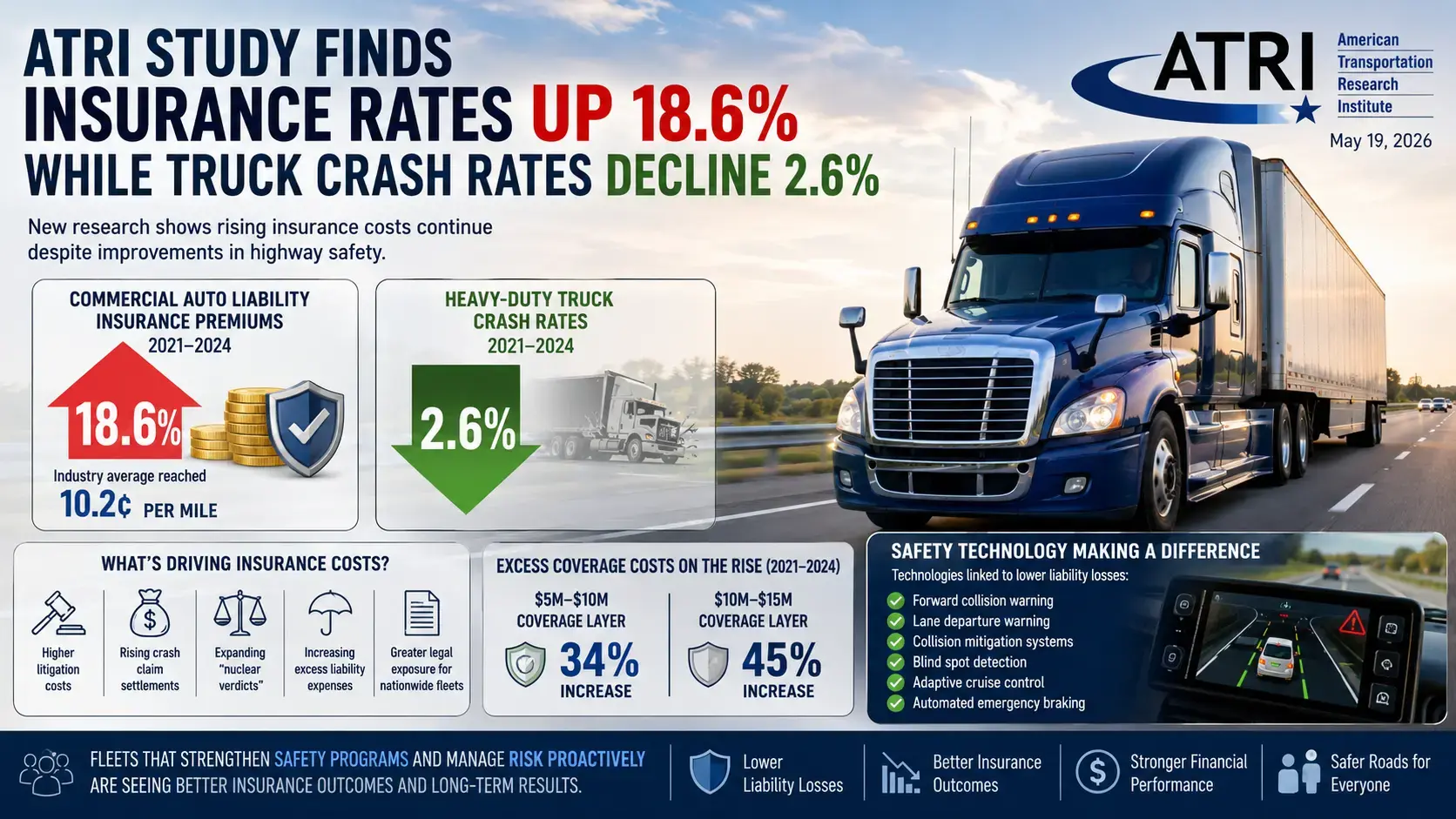
In its latest report, Trucking’s Rising Insurance Costs: Issues and Opportunities, ATRI found that commercial auto liability insurance premiums for motor carriers increased by 18.6% between 2021 and 2024. This trend reaches an industry average of 10.2 cents per mile, heavily impacting routes scheduled for OTR CDL-A jobs across the USA.
What makes the findings especially notable is that the rise in insurance expenses occurred while heavy-duty truck crash rates actually declined by 2.6% industry-wide. Liability costs remain one of the most critical operational bottlenecks, only following overarching fuel margins and macroeconomic challenges.
EXCESS LAYERS JUMP
One of the most significant trends identified in the report involves excess insurance layers — additional coverage purchased above primary liability policies. This spike is altering budget frameworks for national carriers and those structuring regional CDL-A truck driving jobs.
From 2021 to 2024, premium costs for the $5–$10 million coverage layer rose by 34%, while the $10–$15 million layer surged by an astounding 45%.
Industry analysts highlight that these massive increases reflect the growing financial weight of large-scale trucking lawsuits and multimillion-dollar "nuclear verdicts." Consequently, top carriers are forced to treat legal defense and safety performance as equivalent pillars of survival.
SAFETY TECH IMPACT
In spite of rising rates, ATRI’s research highlighted a reassuring connection between advanced safety technology and premium stabilization. Fleets deploying proactive driver-assistance devices achieved substantially improved liability outcomes.
Six main technologies showed statistically significant correlations with reduced per-mile liability losses: Forward Collision Warning, Lane Departure Warning, Collision Mitigation Systems, Blind Spot Detection, Adaptive Cruise Control, and Automated Emergency Braking.
Drivers looking to secure top-tier pay profiles can use our truck driver salary calculator to see how carriers utilizing safety-enhanced fleets avoid liability drag and allocate higher compensation to clear-record pilots.
RISK RETENTION
To cope with climbing overheads, trucking companies are adapting through internal changes, such as increasing self-insured deductibles, retaining higher initial risk layers, and focusing on specialized safety-monitoring systems.
This shifting landscape directly influences independent operators in owner-operator CDL-A trucking jobs USA, who face the choice of paying higher out-of-pocket premiums or coordinating with larger fleets that lease out coverage benefits.
DRIVER IMPACT
Successful fleets are no longer accepting premium jumps as simple costs of doing business. Instead, they actively pair operational statistics with modern in-cab technologies to prove a low-risk profile to top-underwriters.
For commercial drivers, including those looking into local CDL-A truck driving jobs, this dynamic translates directly into stricter hiring qualifications, expansion of cabin-facing camera feeds, and a heightened emphasis on absolute accident prevention.