RECORD DIESEL & THE WORKING-CAPITAL CRUNCH
The national average price of diesel reached approximately $6.53 per gallon in September, setting a new record and surpassing the previous national high of about $5.81 recorded in 2022. Although the national average has eased somewhat from the September peak, fuel remains dramatically more expensive than it was a year ago.
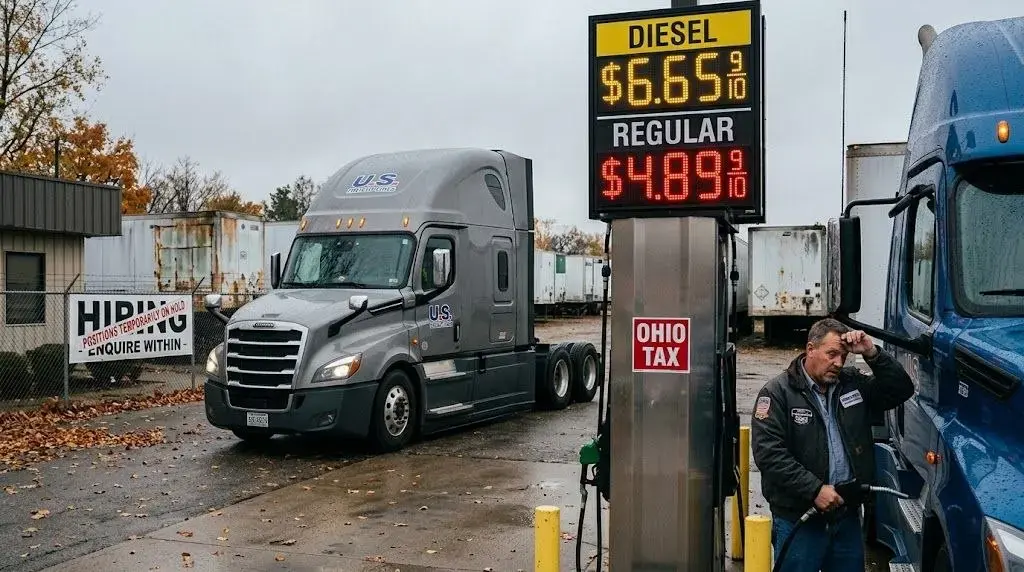
In Ohio, the situation is particularly difficult for trucking companies. Diesel prices hovered around $6.65 per gallon on October 2, compared with approximately $3.66 per gallon at the same time last year, according to reporting by The Columbus Dispatch. That represents an increase of almost $3 per gallon in roughly one year.
Fuel Costs Are Creating a Cash-Flow Problem
The biggest challenge for many carriers is not simply the higher price of diesel. It is the timing of when companies have to pay for fuel compared with when they receive compensation from customers.
Trucking companies must purchase diesel immediately at the pump to keep trucks rolling and deliver freight. However, the additional fuel costs are often recovered through fuel-surcharge programs that are tied to specific fuel-price indexes and customer contracts. Those surcharges do not provide immediate reimbursement.
The 30 to 120 Day Reimbursement Delay
Ohio trucking executives told The Columbus Dispatch that companies may wait 30 to 120 days, and sometimes three to four months, before receiving the revenue associated with fuel surcharges. A carrier can therefore be technically recovering fuel expenses on paper while having to finance millions in out-of-pocket cash across fleet operations.
$6.53 / Gal National Peak
Surpasses 2022 Benchmark
Shattered the previous national record of $5.81/gal, elevating operating thresholds across all freight divisions.
Ohio: Up Nearly $3/Gal
$6.65 vs $3.66 Last Year
Represents a devastating 75%+ increase in raw fuel expenditures for Midwest freight operations.
INDEX LAG, PAYMENT LAG & SMALL FLEETS
Fuel Surcharges Do Not Always Move as Quickly as Diesel Prices
Fuel surcharge systems are designed to help carriers and shippers share the impact of changing fuel prices, but the formulas and timing vary significantly between contracts. Some agreements use weekly fuel-price indexes. Others may have different adjustment schedules, regional benchmarks, baseline prices or mileage assumptions.
C.H. Robinson noted in its October freight-market update that the immediate concern for freight transportation is not only the price of diesel but also the timing between rising fuel costs and adjustments to shipper fuel surcharges.
The Double Squeeze on Motor Carriers:
1. Index Lag
Diesel prices can escalate at truck stops days or weeks before contractual surcharge formulas officially update.
2. Payment Lag
Even after a fuel surcharge appears on a delivered invoice, the carrier often waits 30 to 120 days before customer remittance clears.
Smaller Carriers and Owner-Operators Face Greater Pressure
The impact is particularly acute for smaller trucking companies and independent owner-operators.
Large enterprise carriers often possess revolving credit lines, negotiated fuel card discount networks, bulk terminal fueling, and diversified customer portfolios. Smaller operators typically operate on tighter cash reserves with limited borrowing capacity.
For an owner-operator, fuel is the single largest recurring cost for every loaded and empty mile. A truck consuming 200–300 gallons of diesel weekly experiences a severe jump in cash outlays even if total miles remain identical, wiping out take-home pay even when top-line gross revenue looks steady.
ATA TONNAGE INDEX & CAPACITY CONDITIONS
Entering a Fuel Shock After Years of Weak Freight
The timing of this diesel spike comes after several grueling years for commercial trucking following the post-pandemic freight boom. During that expansion, carriers added substantial capacity. When consumer demand normalized, overcapacity drove freight spot rates down to breakeven levels.
Now, while capacity is tightening, freight demand itself remains uneven across key freight corridors.
American Trucking Associations (ATA) Tonnage Data:
- The seasonally adjusted For-Hire Truck Tonnage Index fell 0.5% in August, following a 1.2% contraction in July.
- The August index stood at 112.7 (down 1.6% compared to August 2025).
- Tonnage has fallen in four of the past five months and is down 4.3% from its March peak.
- Year-to-date tonnage remains up 1% over 2025 due to early-year gains.
ATA Chief Economist Bob Costello emphasized that recent improvements in the freight market have been driven more by reduced carrier capacity (fleet attrition) than by genuine surges in underlying freight volume.
Higher Diesel Prices Can Push Freight Rates Higher
As fuel costs escalate, carriers must respond by negotiating higher base contract rates, tightening surcharge terms, or declining low-margin lanes.
However, contractual freight commitments negotiated months or years earlier limit a carrier's ability to immediately pass higher expenses onto shippers. Because fuel surcharges do not capture 100% of out-of-route, deadhead, or reefer auxiliary fuel consumption, carrier operating margins remain under intense pressure.
REGIONAL GAPS, CONSUMER IMPACT & OHIO RELIEF
Regional Disparities in Fuel Pricing
National averages mask severe regional variances. West Coast pump prices trade at a substantial premium over Gulf Coast and Midwest markets due to regional refining constraints and environmental fuel specifications.
A carrier running regional routes in the Midwest faces a vastly different cost curve than a cross-country fleet routing through California, Washington, or Oregon, making fuel stop optimization and corporate card discounts paramount to survival.
Ohio Fleets Feel the Squeeze: Continental Express Example
Ohio illustrates how quickly fuel inflation disrupts fleet balance sheets. According to The Columbus Dispatch, Sidney-based Continental Express reported fuel costs roughly 75% higher than a year earlier. Company executives noted they cannot instantly hike rates on long-term shipper contracts, forcing the carrier to finance massive fuel outlays up front.
Ohio Moves to Suspend 47-Cent State Fuel Tax
On October 2, Ohio lawmakers moved forward with legislation to temporarily suspend the state's 47-cent-per-gallon diesel tax for 90 days. For fleets purchasing tens of thousands of gallons weekly inside Ohio, this provides crucial immediate cash relief, although it does not insulate interstate carriers when fueling across border states.
Ripple Effects on Retail and Consumer Goods
Because nearly all consumer staples, food, industrial components, and building supplies move by truck, sustained diesel increases inevitably work their way through wholesale distributors to supermarket shelves and consumer goods, exerting fresh inflationary headwinds on the wider economy.
WHAT THIS MEANS FOR CDL-A DRIVERS & RECRUITING
For professional truck drivers, higher diesel prices alter daily operations and freight lane selections, even when company drivers do not pay for fuel out of pocket.
Motor carriers operating under tightened margins become increasingly selective about lane profitability, dispatch schedules, and equipment utilization. Fleets place renewed emphasis on progressive shifting, speed limiters, idle reduction policies, and minimizing uncompensated deadhead miles.
The impact of fuel inflation differs markedly across freight divisions:
Local & Dedicated Delivery
Drivers in local CDL-A truck driving jobs USA often benefit from centralized terminal fueling and predictable metro routes, though carriers vigorously enforce idle management during multi-stop deliveries.
Regional Freight Networks
Operators running dedicated multi-state freight via regional CDL-A truck driving jobs must navigate customer surcharge adjustments while maintaining scheduled home-time windows.
Long-Haul & Over-the-Road Lanes
Drivers logged in high-mileage OTR CDL-A jobs across the USA face strict fuel-route compliance, where dispatch systems dictate specific truck stops to capitalize on volume discount pricing across state borders.
For drivers compensated on a cents-per-mile basis, carriers with well-structured fuel surcharges and stable long-term contracts provide superior earnings protection compared to spot-market operators vulnerable to cash-flow crunches.
THE FOURTH QUARTER OUTLOOK & SOURCES
What Trucking Companies Are Watching Now
As the fourth quarter gets underway, motor carriers are balancing four interconnected metrics:
- Diesel Price Trajectory: Whether national benchmarks continue cooling from September's $6.53 peak.
- Surcharge Responsiveness: How quickly customer surcharge schedules absorb recent fuel hikes.
- Underlying Freight Volumes: Whether peak season retail and industrial volumes bolster tonnage.
- Active Fleet Capacity: The pace of carrier insolvencies or capacity stabilization across the spot market.
C.H. Robinson advised enterprise shippers that 2027 transportation budgets should anticipate elevated fuel expenses relative to historical norms, warning that refinery bottlenecks and global supply constraints will keep diesel volatile regardless of benchmark crude swings.
Conclusion: Operating in a High-Cost Environment
The U.S. trucking sector enters late 2026 under a demanding dual dynamic: fuel costs have escalated faster than conventional working-capital reserves can comfortably absorb, while freight demand has not yet rebounded into a full-scale boom.
Carriers with disciplined fuel hedging, robust shipper relationships, and efficient equipment will endure this test of balance sheets, while fleets unable to bridge the surcharge payment gap face mounting operational headwinds.
Official Sources & References:
- The Columbus Dispatch, October 2, 2026 — Ohio diesel prices, state fuel tax suspension, and trucking-industry impact.
- American Trucking Associations (ATA), September 22, 2026 — August For-Hire Truck Tonnage Index.
- C.H. Robinson, October 2, 2026 — North America Freight Market Update and diesel market analysis.
- U.S. Energy Information Administration (EIA) — Weekly U.S. on-highway diesel price data.