THE 435-MILE DALLAS–LAREDO AUTONOMOUS ROUTE
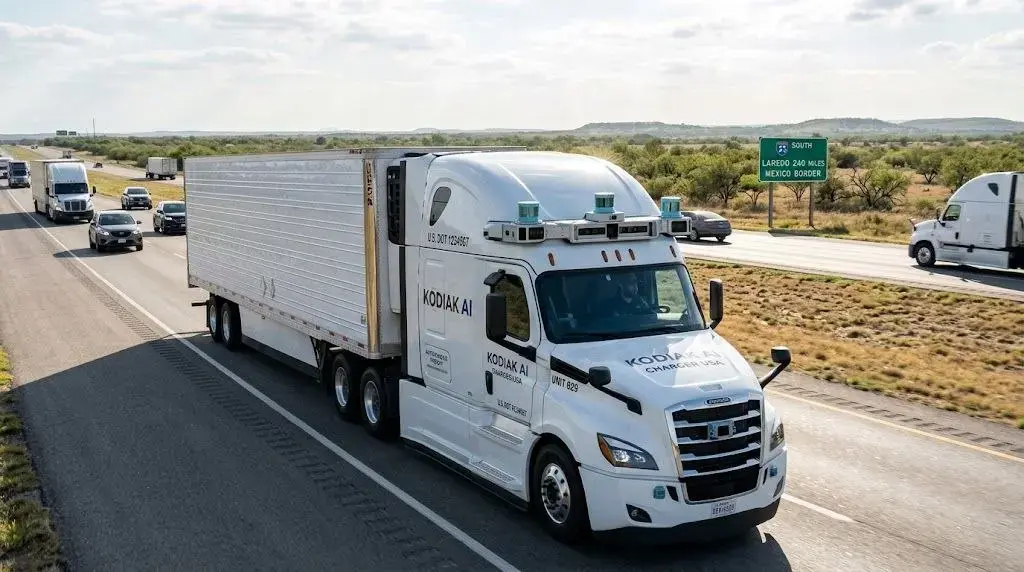
Announced on October 8, 2026, the partnership uses Kodiak's autonomous driving system, Kodiak Driver, to support freight transportation between Charger USA's Dallas and Laredo terminals across approximately 435 miles of Texas highways.
The companies are targeting freight movements for consumer packaged goods (CPG), food and beverage customers, creating a practical application for autonomous technology on a route that connects North Texas distribution networks with one of the country's most critical U.S.–Mexico trade gateways.
The first commercial delivery under the partnership was successfully completed on September 8, 2026. The service is currently operating with a human safety driver behind the wheel while Kodiak continues work toward potential driverless operations.
Supervised Commercial Freight Operations
An essential distinction is that the Dallas–Laredo service is not yet operating as a fully driverless freight network. Having a safety driver onboard provides human presence and oversight while the companies gather operational experience and evaluate system performance across varying traffic flows, loading schedules, and weather patterns.
435-Mile Corridor
Dallas to Laredo, TX
Direct link between North Texas distribution hubs and the bustling international border crossing at Laredo.
Reefer & Dry Van
CPG & Food / Beverage
Transports high-value food, temperature-controlled perishables, and retail packaged goods under strict monitoring.
STRATEGIC CONNECTION TO U.S.–MEXICO TRADE
Why the Dallas–Laredo Corridor Is Important
The Dallas–Laredo route connects two locations with different but complementary roles in the national freight transportation network:
- Dallas–Fort Worth: A premier national inland distribution and logistics hub supporting regional fulfillment, retail warehousing, and heavy multi-state manufacturing.
- Laredo, Texas: The undisputed primary commercial land gateway for bilateral trade between the United States and Mexico, moving billions in cross-border freight.
Truck transportation is the lifeblood of these cross-border supply chains because shipments arriving from Mexico must be rapidly transferred between border bonded warehouses and major interior distribution centers. Introducing autonomous driving technology on this corridor allows the companies to evaluate its utility within existing freight networks rather than creating an isolated demonstration loop.
Why Highway Lanes Suit Autonomous Systems
Autonomous developers prioritize long-distance interstate highways because long-haul lanes feature predictable geometries, recurring schedules, and known terminal-to-terminal points compared to congested city streets.
However, repeatable highway routes do not eliminate operational complexity: changing traffic patterns, construction work zones, sudden high winds, and erratic passenger vehicle behavior demand sophisticated real-time responses.
WHAT IS KODIAK DRIVER?
Kodiak Driver is Kodiak AI's specialized autonomous driving system built for Class 8 commercial trucking. It performs driving functions through a synchronized trio of perception, planning, and vehicle-control stacks:
1. Perception
Cameras, LiDAR, and radar sensor pods scan hundreds of meters ahead and 360 degrees around the tractor-trailer, detecting vehicles, pedestrians, debris, and lane markings in diverse lighting conditions.
2. Planning
High-performance onboard computing evaluates surrounding vehicle speeds and trajectories, calculating safe navigation paths, lane changes, and safe stopping distances.
3. Vehicle Control
Sends redundant steering, throttle, and braking actuations engineered specifically to manage 80,000-pound combination vehicles safely at highway speeds.
Beyond Software: The Complete Operating Ecosystem
A commercial autonomous truck is part of a broad physical and logistical system. Performance relies heavily on mechanical vehicle health, sensor cleaning and calibration, telematics monitoring, dispatch coordination, and rapid roadside response protocols.
SAFETY DRIVERS & THE TRANSITION TO DRIVERLESS
Kodiak and Charger USA have stated their intention to transition toward driverless operations after Kodiak completes its safety case for the Texas highway environment.
What Is a Safety Case?
A safety case is a rigorous, structured body of evidence and engineering analysis demonstrating that an autonomous vehicle can operate safely under defined conditions (Operational Design Domain). It systematically documents how the system identifies hazards, handles hardware or sensor failures, responds to unexpected obstructions, and executes safe pull-overs.
Driverless Does Not Mean Unrestricted
Even when driverless operations begin, vehicles do not operate unconditionally anywhere. Autonomous fleets operate under precise geographic and environmental boundaries, such as daylight hours, approved weather thresholds, and specific interstate links between designated transfer terminals.
For now, the Dallas–Laredo operation is characterized as supervised autonomous freight transportation, with driverless runs remaining a conditional future objective.
WHAT AUTONOMOUS TRUCKING MEANS FOR CDL-A DRIVERS
The expansion of autonomous routes understandably sparks questions among professional truck drivers. However, the Dallas–Laredo launch does not signal that conventional CDL-A jobs are disappearing or that cross-country trucking is ready for unattended automation.
Trucking encompasses far more than steering between highway lines. Professional freight movement depends fundamentally on terminal maneuvers, pre-trip and post-trip DOT inspections, cargo load securing, temperature-control monitoring, bad-weather decisions, and client relationship management.
Continued Strong Demand Across Core Trucking Sectors
For drivers seeking active commercial opportunities, professional trucking roles remain indispensable and highly sought after:
Local Distribution & Urban Logistics
Complex city navigation, tight dock backing, customer interaction, and same-day freight movement anchor steady opportunities in local CDL-A truck driving jobs USA, where human dexterity and judgment cannot be replicated by automated software.
Regional Dedicated Corridors
Shippers depend on human expertise for tight delivery windows and dedicated distribution networks via regional CDL-A truck driving jobs, pairing dependable miles with weekly home time.
Long-Haul & Over-the-Road (OTR) Freight
Cross-country long hauls across mountainous terrain, severe winter storms, and irregular routes continue to rely on skilled drivers in OTR CDL-A jobs across the USA, where independent decision-making and mechanical troubleshooting are essential.
What Drivers Should Watch
Drivers should monitor whether carriers adopt autonomous pilot partnerships, whether new technician or fleet oversight roles emerge, and the progression of safety validation across varied weather and highway conditions.
FLEET ECONOMICS, OUTLOOK & SOURCES
Potential Benefits and Operational Challenges
For carriers, autonomous systems offer potential long-term scheduling flexibility on high-volume lanes. However, the business case requires balancing major capital expenditures in specialized sensors and compute units against maintenance overhead, insurance liability, remote monitoring infrastructure, and customer cargo compliance.
Kodiak has stated that it aims to begin driverless operations by late 2026, contingent upon complete safety validation. Future lane expansions will be assessed on a route-by-route basis according to freight volume, weather exposure, and infrastructure readiness.
Bottom Line:
Kodiak AI and Charger USA have proven real-world freight execution on the 435-mile Texas trade corridor under active safety driver supervision. While autonomous technology is advancing into commercial supply chains, professional CDL-A drivers remain the backbone of the freight industry across America.
Official Sources & References:
- Kodiak AI, Kodiak AI and Charger USA Launch Autonomous Trucking Between Dallas and Laredo, October 8, 2026: https://kodiak.ai/news/kodiak-charger-usa-autonomous-trucking-dallas-laredo
- Trucking Dive, Kodiak, Charger launch 435-mile autonomous lane in Texas, October 21, 2026: https://www.truckingdive.com/news/kodiak-charger-launch-435-mile-autonomous-lane-in-texas/832826/