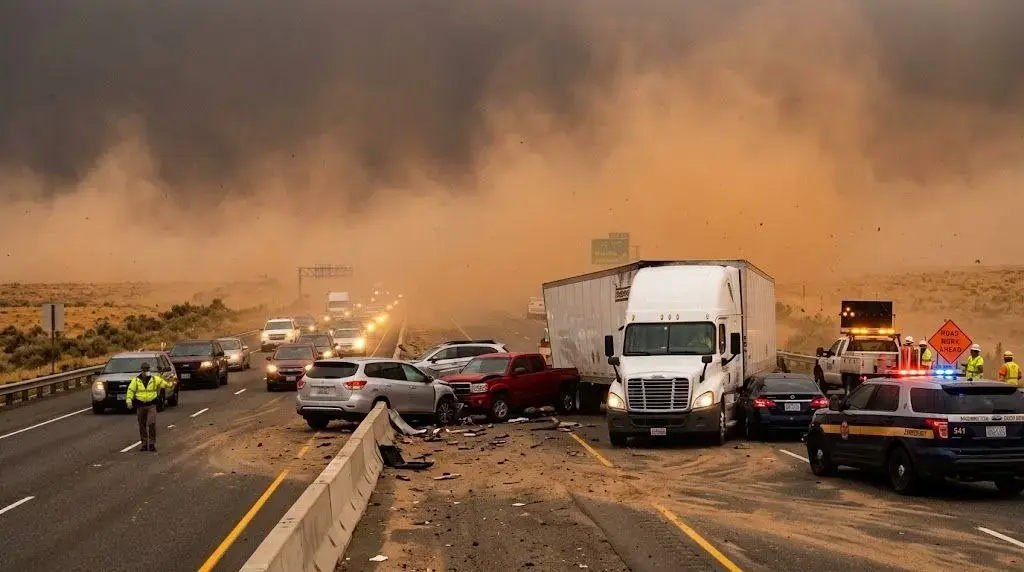
MULTIPLE CRASHES & ROAD CLOSURES
Blowing dust dramatically reduced visibility along the highway, at times creating near-zero visibility for drivers. Several vehicles were involved in crashes, including at least one semi-truck, according to the Washington State Patrol.
The dangerous conditions also affected State Route 261, which was temporarily closed following crashes and severely reduced visibility. Transportation officials urged motorists to use caution as blowing dust continued to affect travel in the area.
Multiple Crashes Reported on I-90
The dust storm developed in an area of eastern Washington where strong winds can quickly lift loose soil and agricultural dust from surrounding fields onto major highways.
According to the Washington State Patrol, multiple vehicles were involved in collisions after visibility deteriorated rapidly. The presence of a semi-truck among the vehicles involved highlights the particular risks that sudden dust storms can create for commercial drivers.
When visibility drops within seconds, drivers may have very little time to identify stopped traffic, disabled vehicles or changing road conditions ahead. For tractor-trailer operators, the situation can be especially difficult because of the greater stopping distance and size of commercial vehicles.
I-90 Traffic Restrictions & State Route 261 Closure
The dust-related incidents caused significant disruptions to traffic on Interstate 90. As of the latest updates, westbound I-90 had reopened, while eastbound traffic remained restricted to a single lane in the affected area.
Even after a highway begins reopening, conditions can remain dangerous. Dust may continue to blow across the roadway, while emergency crews, disabled vehicles and crash debris can create additional hazards. Drivers approaching the affected area should therefore pay attention to changing traffic conditions rather than assuming that a reopened highway has returned to normal operating conditions.
The dust storm also disrupted travel on State Route 261, which was temporarily closed because of crashes and poor visibility. SR 261 connects communities and transportation routes in eastern Washington and can serve as an important regional route for local traffic and commercial vehicles.
Interstate 90 Status
Near Ritzville Milepost
Westbound lanes reopened; eastbound restricted to single lane with ongoing safety delays and emergency presence.
State Route 261
Secondary Arterial Closed
Closed following multiple collisions and zero-visibility conditions; regional detour options severely restricted.
WHY BLOWING DUST IS DANGEROUS FOR TRUCK DRIVERS
Dust storms can create a particularly dangerous combination of hazards. The most immediate problem is visibility. A driver traveling at highway speed may suddenly lose the ability to see vehicles only a short distance ahead.
Unlike ordinary fog, which may develop gradually, blowing dust can move across a roadway rapidly as wind conditions change. A driver who enters an area with clear visibility may encounter severely reduced visibility only moments later. The problem becomes more serious when traffic ahead has already slowed or stopped because of the storm.
1. Drastically Reduced Visibility
When visibility drops sharply, drivers may not have enough time to recognize a stopped vehicle or obstacle.
This is particularly critical for commercial truck drivers because a fully loaded tractor-trailer (up to 80,000 lbs) requires significantly more distance to stop than a passenger car under comparable highway conditions.
2. Chain-Reaction Collisions
A sudden visibility drop sharply escalates the potential for secondary pile-ups.
If one vehicle slows or strikes debris and following motorists cannot see the brake lights in time, multiple secondary collisions can occur within seconds, putting drivers and first responders at severe risk.
3. Severe Crosswinds & Traction Loss
Dust storms are driven by powerful atmospheric pressure gradients and intense wind gusts.
High-profile equipment, empty dry vans and refrigerated trailers act as giant sails against crosswinds. Simultaneously, fine silt deposited on asphalt reduces tire traction and makes road feedback unpredictable.
EASTERN WA GEOGRAPHY & NWS WARNINGS
Eastern Washington's Exposure to Dust Storms
Eastern Washington contains extensive agricultural areas where dry soil can become airborne during periods of strong winds. Major transportation corridors such as I-90 pass through areas where highways are surrounded by open farmland and relatively exposed terrain.
Under the right weather conditions, blowing dust can move rapidly across roads and substantially reduce visibility. For professional drivers, this means that weather conditions along the route can change even when conditions at the terminal or origin point are relatively normal. A route that begins under clear skies in Spokane or the Columbia River Basin may encounter hazardous conditions hundreds of miles later.
National Weather Service Issues Dust Storm Warning
The National Weather Service issued a dust storm warning for Adams County, identifying the conditions as hazardous for travel.
Weather warnings involving blowing dust are particularly important for drivers because the greatest danger can occur when visibility changes faster than motorists can safely adjust their speed. Commercial drivers should monitor weather conditions throughout a trip rather than relying only on conditions observed at departure.
For long-haul drivers crossing Washington, updated weather information can help identify developing hazards before reaching an affected highway segment.
WHAT TRUCK DRIVERS SHOULD DO WHEN VISIBILITY DROPS
When a dust storm begins affecting visibility, professional drivers should prioritize maintaining control of the vehicle and avoiding sudden maneuvers. Recommended precautions include:
- Reduce speed immediately when visibility begins to deteriorate.
- Increase following distance substantially from vehicles ahead.
- Avoid sudden lane changes or hard braking unless necessary to prevent a collision.
- Watch for stopped or disabled vehicles along travel lanes and shoulders.
- Follow instructions from law enforcement and transportation officials.
- Monitor WSDOT traffic information for real-time closures and restrictions.
- Check National Weather Service alerts before continuing through an affected area.
- Consider delaying travel or taking an approved alternate route when authorities advise against entering the area.
Why Truck Drivers Need Extra Caution
If visibility becomes dangerously low, drivers should use extreme caution when deciding whether and where to stop. Pulling onto an active travel lane or an unsafe shoulder can create another collision hazard. Commercial drivers should follow company safety procedures and instructions from emergency personnel when conditions become severe.
A dust storm presents different challenges for a professional driver than for someone making a short passenger-vehicle trip. Truck drivers operate vehicles weighing tens of thousands of pounds, traveling at highway speeds and carrying freight that can affect braking and handling. A sudden obstruction or stopped vehicle can therefore leave very little room for correction.
The incident near Ritzville also demonstrates why drivers should avoid assuming that a familiar route will remain safe throughout an entire trip: weather conditions can change rapidly across open agricultural corridors.
FREIGHT MOVEMENT & TRUCKING CAREERS
Interstate 90 is a major east-west transportation corridor across Washington and a vital national artery for commercial freight. Temporary lane restrictions, crashes and highway closures can affect trucking schedules well beyond the immediate incident area.
Potential Supply Chain & Driver Impacts:
- Delayed deliveries and cascading supply disruptions
- Missed appointment windows at distribution hubs
- Longer driving times and accumulated driver fatigue
- Increased fuel consumption from idle and detours
- Unplanned route deviations onto secondary rural highways
- Severe congestion around detour junctions
- Extended turnaround delays for emergency and recovery operations
Impact Across Professional Driving Segments
A sudden shutdown on major east-west corridors like I-90 impacts every operational segment of commercial freight:
For drivers handling short-haul dispatch and distribution in local CDL-A truck driving jobs USA, unexpected closures mean navigating cramped detour roads and adjusting daily schedules to return home safely. Meanwhile, commercial haulers running multi-state Pacific Northwest corridors via regional CDL-A truck driving jobs must coordinate closely with dispatchers to protect tight delivery windows and preserve weekly home-time guarantees. For cross-country operators logging heavy miles in OTR CDL-A jobs across the USA, highway halts require careful management of Hours of Service (HOS) logs, safe truck parking locations, and fuel stops while waiting out severe zero-visibility advisories.
For carriers operating time-sensitive freight, even a temporary highway restriction can require dispatchers and drivers to reassess the planned route.
OFFICIAL UPDATES, OUTLOOK & SOURCES
Drivers Should Monitor Official Updates
Conditions around a dust storm can change quickly as wind speeds, visibility and crash-response operations change. Drivers traveling through eastern Washington should rely on official updates from the Washington State Department of Transportation (WSDOT) and Washington State Patrol for current highway conditions.
The National Weather Service should also be monitored for updated weather alerts and warnings. Drivers should not rely solely on navigation applications when severe weather or emergency closures are occurring; navigation systems may take time to reflect temporary restrictions, lane closures or newly reported crashes.
A Reminder About Sudden Highway Hazards
The Ritzville-area incident is another reminder that dangerous driving conditions do not always involve snow, ice or heavy rain. Blowing dust can create an equally serious visibility hazard, particularly on open highways surrounded by dry agricultural land.
For truck drivers, the safest response is to recognize deteriorating conditions early, reduce speed, maintain additional following distance and follow instructions from transportation and emergency officials. When authorities recommend delaying travel or avoiding an affected highway, waiting for conditions to improve may be safer than attempting to continue through a rapidly changing dust storm.
Outlook for Travelers in Eastern Washington
As of the latest reports on September 26, westbound I-90 had reopened while eastbound traffic remained restricted in the affected area. Conditions could continue to change as crews respond to crashes and wind and visibility conditions evolve.
Truck drivers and other motorists traveling through the Ritzville, Adams County and eastern Washington region should check current road and weather information before entering affected routes. For commercial drivers, a few minutes spent checking road conditions before approaching a hazardous area can help prevent a much longer delay — or a serious collision.
Official Sources & References:
- Washington State Patrol (WSP) Incident Reports
- Washington State Department of Transportation (WSDOT) Road Alert System
- National Weather Service (NWS) Dust Storm Advisory – Adams County
- Reporting by KIRO 7 and KHQ News, September 26, 2026