


SEASON OVERVIEW
Colorado law enforcement officials have released expanded enforcement results from the 2025–2026 winter chain law season, reporting thousands of violations involving commercial motor vehicles operating across key mountain freight corridors.
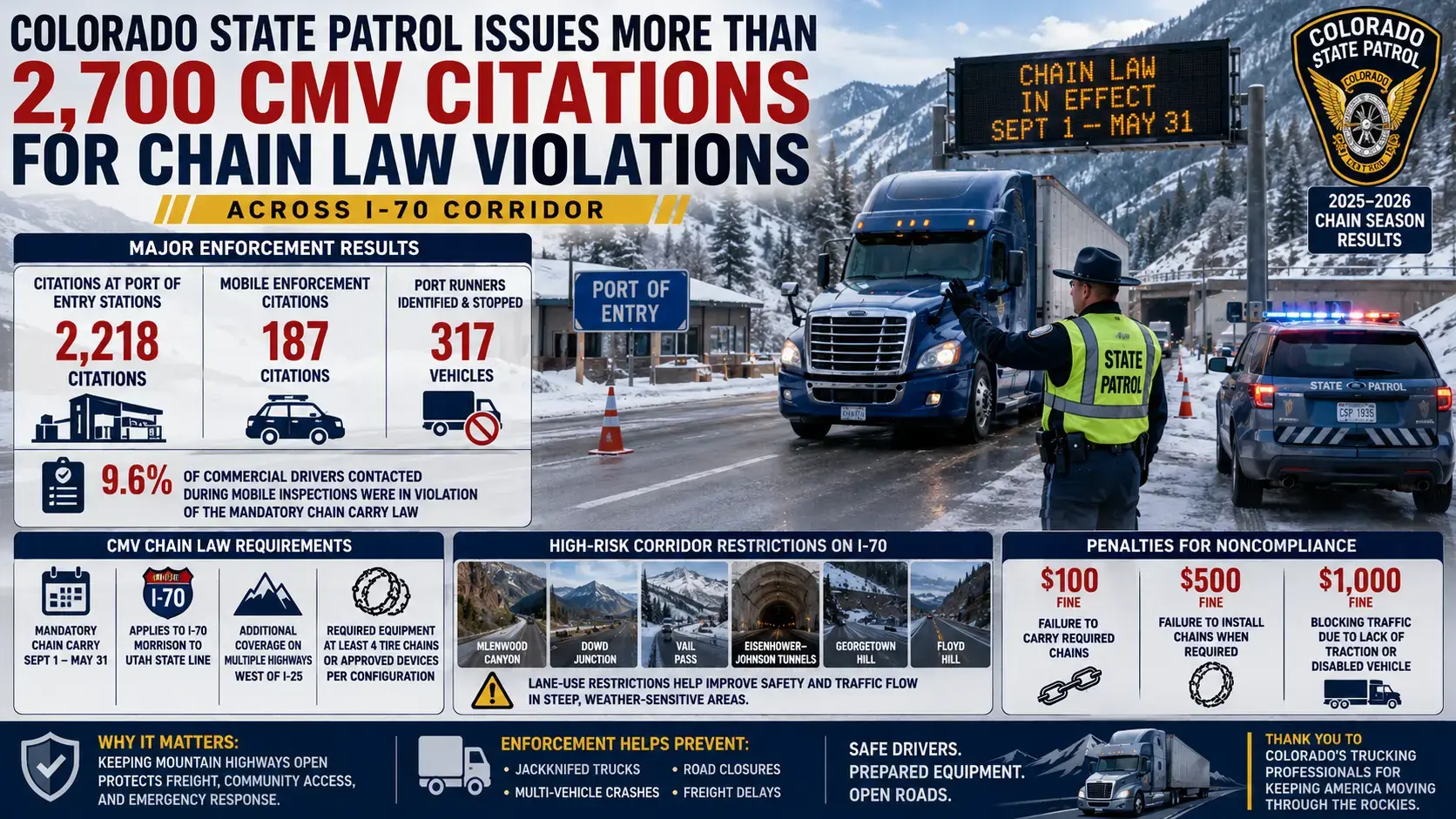
The latest data from the Colorado State Patrol shows that officers issued more than 2,700 citations to commercial drivers for failing to comply with Colorado’s mandatory tire chain requirements. This intensive winter initiative heavily affected route dynamics for those in OTR CDL-A jobs across the USA.
Officials say the enforcement effort is part of a broader strategy to keep critical mountain highways open, reduce winter-related crashes, and prevent freight disruptions along one of the most important trucking routes in the western United States.
DETAILED VIOLATIONS
State Patrol officials confirmed that enforcement was conducted continuously throughout the chain season, which runs from September 1 through May 31, with intensified operations during severe winter weather events.
According to the official report, enforcement results included 2,218 citations issued at Port of Entry inspection stations, 187 citations issued during mobile roadside enforcement, and 317 “port runners” identified and stopped after bypass attempts.
Troopers also reported that during mobile inspections, approximately 9.6% of commercial drivers contacted were in violation of the Mandatory Chain Carry Law, meaning they did not have required traction devices onboard. Running high-mountain passes safely helps commercial drivers protect their records; you can review potential earnings using our truck driver salary calculator to compute how clean runs and high compliance prevent expensive delays.
ROCKIES SUPPLY CHAIN
Colorado officials emphasize that the chain law is not only a safety regulation but also a critical infrastructure protection measure designed to prevent full highway shutdowns. Coordinated patrol activity focused deeply on Interstate 70 to ensure secure commercial throughput.
When commercial vehicles become disabled or block lanes due to inadequate traction, entire mountain segments can shut down quickly. This impacts local communities, emergency services, tourism, and national distribution corridors.
These mountain segments are heavily traveled by carriers handling regional CDL-A truck driving jobs, making rapid response and preventative chaining essential to keep lanes moving and regional delivery schedules intact.
CMV CHAIN RULES
Colorado’s CMV Chain Law applies to all commercial vehicles with a gross vehicle weight rating (GVWR) over 16,001 pounds. Drivers operating in designated areas must carry approved tire chains or equivalent traction devices during the enforcement season.
These requirements demand advanced preparations by independent truck owners. For those working in owner-operator CDL-A trucking jobs USA, keeping top-quality, lightweight tire wrappers or chains in their toolboxes ensures fully compliant mountain crossings without safety or legal penalties.
FINES & CARRIER IMPACT
Penalties for noncompliance are structured strictly: a $100 fine for failure to carry required chains, a $500 fine for failing to install them when conditions dictate, and a massive $1,000 fine if a vehicle blocks traffic due to lack of traction.
To mitigate these legal and financial risks, fleets operating on western lanes are increasingly stepping up practical driver training. For pilots serving in local CDL-A truck driving jobs in nearby hubs, having robust weather tools and pre-checks keeps operations safe and compliant across all altitudes.
