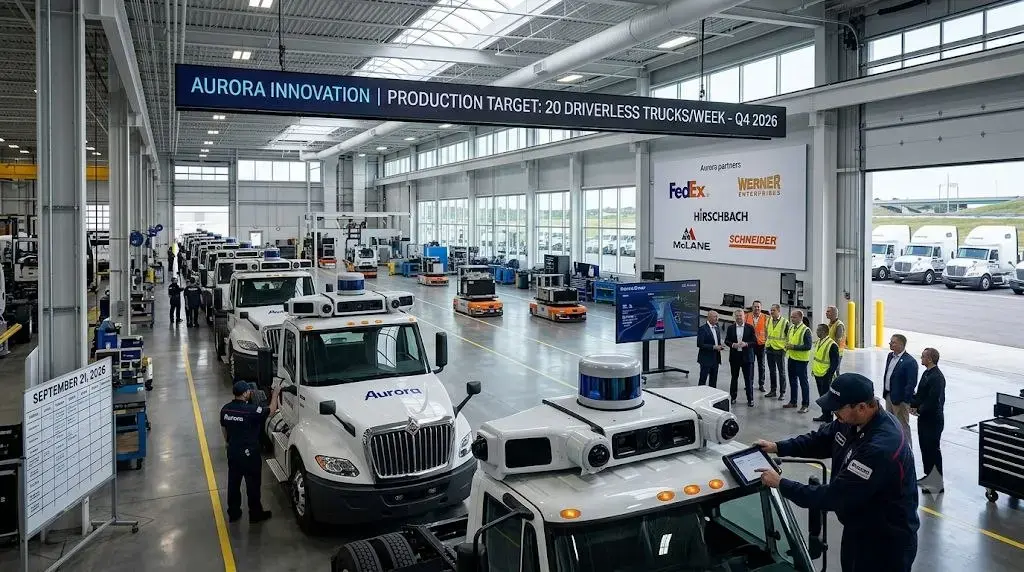
AURORA TARGETS 20 DRIVERLESS TRUCKS WEEKLY
Aurora Innovation is preparing for a major expansion of its autonomous trucking operations, with the company targeting production of 20 driverless trucks per week during the fourth quarter of 2026.
The announcement represents another step in the development of autonomous freight transportation in the United States. Rather than treating autonomous trucks as a limited testing project, Aurora is now focusing on manufacturing scale, commercial customers and integration with major truck manufacturers.
Aurora CEO and co-founder Chris Urmson discussed the company's plans at the Morgan Stanley Laguna Conference. According to the company, Aurora expects to finish the current quarter with approximately 20 to 25 trucks in operation before increasing production during Q4.
The company began driverless commercial operations in 2025 and introduced its second-generation autonomous-driving hardware in April 2026.
Second-Generation Hardware Designed for Scale
Aurora says its second-generation system was developed specifically to make autonomous trucking more practical at commercial scale.
According to Urmson, the new hardware is expected to reduce hardware costs by more than 50% compared with the company's first-generation system. Aurora also says the second-generation equipment offers approximately three times the durability of its earlier hardware.
The goal is to reduce the cost of autonomous operation over the life of a truck while making the technology easier to deploy across larger fleets. Aurora expects its second-generation platform to support the production of approximately 1,500 tractors.
The company is already looking beyond the second generation. Aurora plans to introduce third-generation hardware in partnership with AUMOVIO, a Continental spinout, during 2027. The company says the next-generation system is being designed for production at much larger automotive-style volumes, potentially reaching tens of thousands of units.
20 Trucks / Week
Targeting Q4 2026
Moving from pilot fleet numbers to sustained commercial factory conversion rates.
>50% Cost Reduction
Gen-2 Autonomous Suite
3x durability improvement designed to support approximately 1,500 production tractors.
OEM INTEGRATION: INTERNATIONAL & VOLVO
International Trucks Being Converted in Michigan
One of Aurora's current manufacturing approaches involves International trucks and Roush.
Under the current arrangement, International trucks are transported to Roush's facility in Livonia, Michigan, where Aurora's autonomous-driving equipment is installed. The trucks are then prepared for commercial deployment with customers.
Aurora expects the Roush-supported operation to eventually reach an annualized production rate of approximately 1,000 trucks.
This approach allows Aurora to increase deployment without waiting for every component of the autonomous system to be incorporated directly into the truck manufacturer's factory production line. Aurora has indicated that, over time, it would prefer deeper factory integration with International as well.
Volvo Autonomous VNL Trucks Planned for 2027
Volvo is another major part of Aurora's expansion strategy.
Volvo has publicly indicated that it expects to launch autonomous Volvo VNL trucks in the first quarter of 2027 and plans to have more than 300 autonomous trucks on the road during 2027.
Urmson said the majority, if not all, of those trucks are expected to use Aurora's autonomous-driving technology.
Aurora also has a long-term relationship with PACCAR, and the company expects PACCAR to eventually introduce Aurora's third-generation system through a production-line installation.
Aurora has described its relationships with Volvo and PACCAR as particularly important because the two manufacturers together represent a substantial share of the U.S. heavy-truck market. The company has also discussed potential opportunities with other manufacturers, including Daimler and Freightliner.
BUSINESS MODEL TRANSITION & CARRIERS
From Transportation-as-a-Service to Driver-as-a-Service
One of the most significant changes in Aurora's business strategy is the planned transition from Transportation-as-a-Service (TaaS) to Driver-as-a-Service (DaaS).
Under the current TaaS model, Aurora owns and operates autonomous trucks and provides transportation capacity to trucking companies. This gives carriers an opportunity to use autonomous trucks without immediately purchasing and managing the vehicles themselves.
The planned DaaS model is different. Under DaaS, the carrier or fleet operator would own and operate the truck, while Aurora would provide the autonomous-driving technology as a service.
Aurora expects to keep its TaaS fleet at approximately 500 trucks or fewer and transition the majority of its vehicles to the DaaS model by the end of 2027. The change is significant because it positions Aurora more as a technology provider for trucking companies rather than as a traditional trucking carrier.
Major Freight Companies Are Already Involved
Aurora says it is already working with several major transportation and logistics companies. Its customers and commercial partners include:
- FedEx
- Werner Enterprises
- Hirschbach
- Detmar Logistics
- McLane
- Schneider
Aurora says it is fully allocated for 2026 and is seeing growing interest from carriers as more autonomous trucks accumulate real-world operating experience.
The company reports approximately 6 million total miles of autonomous vehicle operation, including nearly 500,000 fully driverless miles.
Those miles are important because autonomous trucking systems must demonstrate performance in a wide range of real-world conditions, including highways, traffic, weather, loading locations and different freight networks.
WHAT THIS MEANS FOR CDL-A DRIVERS
The expansion of autonomous trucking raises an obvious question for professional drivers:
What role will CDL-A drivers have as autonomous trucks become more common?
The current developments do not mean that conventional trucking jobs are disappearing immediately.
Aurora's technology is being introduced gradually, with relatively small fleets compared with the millions of commercial trucks operating in the United States. The company is still expanding manufacturing capacity, working through state regulations and building relationships with carriers. Autonomous trucking is also initially focused on specific freight applications and highway routes rather than every type of commercial driving.
Many trucking jobs involve work that is difficult to automate completely, including local deliveries, customer interactions, loading and unloading, specialized freight, yard operations and routes requiring complex decision-making outside controlled highway environments. For professional drivers seeking high job stability and daily home schedules, local CDL-A truck driving jobs USA represent an area where hands-on human expertise and last-mile maneuverability remain indispensable.
At the same time, autonomous technology could change the structure of some long-haul trucking operations over time. For example, autonomous trucks could potentially handle portions of long-distance highway transportation while human workers remain involved in terminal operations, distribution lanes, equipment management, maintenance, customer service and regional CDL-A truck driving jobs connecting key logistics hubs.
Furthermore, while autonomous developers test highway corridors, nationwide commercial supply chains continue to rely on experienced road drivers across OTR CDL-A jobs across the USA to navigate diverse weather, remote facilities, unpredictable road conditions, and intricate cargo securing protocols.
The exact impact on CDL-A employment will depend on how quickly the technology develops, how carriers adopt it, regulatory decisions and the economics of operating autonomous versus conventional trucks.
REGULATORY LANDSCAPE & NEXT 12–18 MONTHS
Regulation Remains an Important Factor
Autonomous trucking also faces a complex regulatory environment in the United States.
Federal authorities regulate many aspects of vehicle safety, while states have significant authority over how vehicles operate on public roads. Aurora has said that most U.S. states currently permit some form of driverless-truck operation, although requirements differ from state to state.
California remains an important regulatory market. Aurora has received an initial permit there and expects the broader certification process to take additional time. The different rules between states mean that autonomous trucking companies cannot simply deploy the same operating model nationwide without addressing individual state requirements.
The Next 12–18 Months Could Be Important
Aurora's current production targets point to a potentially important period for autonomous trucking.
The company is targeting 20 trucks per week during Q4 2026, while Volvo is preparing for autonomous VNL production in 2027. Aurora is also developing its third-generation hardware and expanding relationships with truck manufacturers.
If those plans progress as expected, autonomous trucks could move from relatively small commercial deployments toward larger fleet operations during 2027.
However, production targets are not the same as completed deployment. Manufacturing, customer adoption, regulatory approvals, safety validation, supply-chain availability and operating economics will all influence how quickly autonomous trucks can scale.
For the U.S. trucking industry, the key question is increasingly shifting from whether autonomous technology can operate on public roads to how quickly it can become a commercially scalable part of the freight network.
For CDL-A professionals, the development is worth watching closely—not because traditional trucking is suddenly disappearing, but because the technology could gradually reshape how long-haul freight, fleet operations and driving jobs are organized in the years ahead.
KEY TAKEAWAYS
Key points from Aurora Innovation's commercial scale announcements:
- Aurora is targeting production of 20 driverless trucks per week in Q4 2026.
- Second-generation hardware reduces costs by >50% with 3x durability across ~1,500 tractors.
- Third-generation hardware planned for 2027 with AUMOVIO for high-volume automotive production.
- Manufacturing partnerships include Roush (International trucks) and Volvo Autonomous VNL launching in Q1 2027.
- Business model shifting from Transportation-as-a-Service (TaaS) to Driver-as-a-Service (DaaS) by late 2027.
- Major fleet partners include FedEx, Werner, Hirschbach, Detmar Logistics, McLane, and Schneider with ~500,000 driverless miles.
- Commercial driving demand remains robust for complex freight, customer handling, local routes, and regional distribution networks.