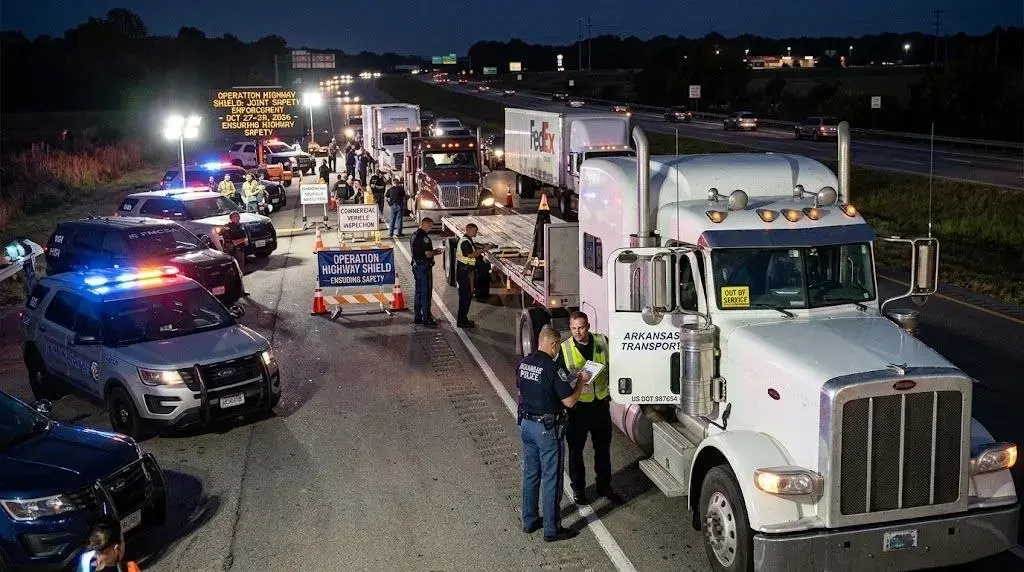
OPERATION HIGHWAY SHIELD: 1,724 INSPECTIONS
A major commercial vehicle enforcement operation in Arkansas has placed renewed attention on driver qualifications, English language proficiency and compliance with federal trucking safety regulations. During a coordinated 48-hour enforcement initiative conducted from October 27 through October 29, state and federal authorities carried out 1,724 commercial vehicle inspections and placed 393 drivers and commercial motor vehicles out of service.
The operation, known as Operation Highway Shield, involved the Arkansas Highway Police (AHP), the Federal Motor Carrier Safety Administration (FMCSA), the Drug Enforcement Administration (DEA), Homeland Security Investigations (HSI) and U.S. Immigration and Customs Enforcement (ICE).
Results reported on November 2 indicate that the operation targeted unsafe commercial vehicles, unqualified or unauthorized drivers, regulatory violations and suspected criminal activity along Arkansas highways.
Key Enforcement Results
| Enforcement Category | Reported Results |
|---|---|
| FMCSA Inspections Completed | 1,724 |
| Drivers and Vehicles Placed Out of Service | 393 |
| Unqualified or Unauthorized Drivers Identified | More than 330 |
| English Language Proficiency (ELP) Disqualifications | 183 |
| Motor Carrier Safety Violations | More than 1,000 |
| Traffic Citations and Warnings | 369 |
| Criminal Arrests | 44 |
| Stolen Trailers Recovered | 1 |
The 393 out-of-service cases included both drivers and commercial motor vehicles. These figures should not be interpreted as 393 driver disqualifications or 393 trucks with mechanical defects. The reported total combines different types of enforcement actions.
Similarly, the more than 1,000 safety violations represent reported violations, not necessarily 1,000 separate vehicles or drivers. The results demonstrate the scale of the operation, but they do not establish that every inspected vehicle or driver was found to be noncompliant.
ENGLISH LANGUAGE PROFICIENCY ENFORCEMENT FOCUS
One of the most notable findings from Operation Highway Shield was the 183 English language proficiency (ELP) disqualifications.
The figure highlights the continued importance of English language requirements for commercial motor vehicle drivers operating in the United States. Under federal regulations, commercial drivers must be able to read and speak English sufficiently to communicate with the general public, understand highway traffic signs and signals, respond to official inquiries and make entries on reports and records.
Federal Regulation: 49 CFR § 391.11(b)(2)
English language proficiency is part of the mandatory federal qualification standards for commercial drivers, rather than simply a preferred professional skill. Drivers must be able to understand instructions concerning vehicle positioning, inspection procedures, safety defects or required documentation.
What FMCSA Requires from Commercial Drivers
- Understanding traffic signs, signals and highway instructions.
- Communicating with law enforcement officers during roadside inspections.
- Responding to questions from officials accurately.
- Providing information about the vehicle, cargo and transportation documents.
- Making required entries on reports and records.
- Understanding instructions relevant to safe vehicle operation.
Drivers who fail to meet applicable English language proficiency requirements may be placed out of service under the relevant enforcement policy. An out-of-service order means the driver cannot continue operating the commercial motor vehicle until the condition is resolved in accordance with governing rules.
Drivers should not assume that holding a valid CDL automatically demonstrates compliance with every applicable qualification requirement. A commercial driver's license confirms that licensing tests were passed, but drivers must continuously maintain federal operating and qualification standards.
MORE THAN 330 UNQUALIFIED OR UNAUTHORIZED DRIVERS
Authorities also reported identifying more than 330 drivers described as unqualified or unauthorized during Operation Highway Shield.
This category highlights another vital area of commercial transportation enforcement: ensuring that individuals operating commercial vehicles meet all legal and regulatory requirements beyond holding a plastic license card.
CDL Classification and Endorsements
Drivers must hold the appropriate commercial driver's license for the vehicle combination they operate. A Class A CDL is generally required for qualifying combination vehicles with a gross combination weight rating (GCWR) of 26,01 pounds or more when the towed unit exceeds 10,000 pounds.
Required Commercial Endorsements:
- H — Hazardous Materials: Required for placarded hazmat transport.
- N — Tank Vehicle: Required for hauling bulk liquids or gases in tanks.
- T — Doubles/Triples: Required for operating multi-trailer combinations.
- X — Tank & Hazmat: Combination endorsement for bulk hazardous liquids.
Medical Examiner's Certification
Commercial drivers must also satisfy physical qualification requirements. For drivers subject to federal medical certification, maintaining a valid medical examiner's certificate (DOT card) is essential. Drivers must ensure medical certificate updates are properly reflected in state licensing records, as a lapse in medical status can instantly disqualify a driver even if the physical CDL card shows a future expiration date.
VEHICLE SAFETY VIOLATIONS & OUT-OF-SERVICE ORDERS
Operation Highway Shield identified more than 1,000 motor carrier safety violations, demonstrating that enforcement placed rigorous scrutiny on vehicle mechanical fitness alongside driver qualifications.
Core Inspection Systems Checked
Brakes: Condition, stroke adjustment, air line leaks, and drum/rotor integrity affecting stopping distance.
Tires and Wheels: Tread depth, tire pressure, cuts, and cracked wheel rims affecting stability.
Lighting & Electrical: Headlights, turn signals, brake lights, and clearance lamps.
Steering & Suspension: Kingpin looseness, tie-rod play, and broken spring leaves.
Coupling Devices: Fifth-wheel latching, safety chains, and pintle hooks.
Cargo Securement: Straps, chains, blocking, and bracing preventing shift or spillage.
Why Pre-Trip Inspections Matter (49 CFR § 396.13)
Under 49 CFR § 396.13, a commercial driver must be satisfied that the motor vehicle is in safe operating condition before driving it. Pre-trip inspections are not administrative formalities; catching a worn brake hose or tire cut in the yard saves thousands in tow bills, out-of-service fines, and delivery delays.
Driver OOS Conditions
Qualifications & ELP
Prohibits the driver from driving until licensing, medical, or language requirements are validated.
Vehicle OOS Conditions
Critical Mechanical Defects
The truck or trailer cannot move until repaired on-site or towed by an authorized service vehicle.
MULTI-AGENCY COORDINATION & DRIVER CHECKLIST
Participating Federal & State Agencies
Operation Highway Shield combined the jurisdictional authorities of five state and federal entities:
- Arkansas Highway Police (AHP)
- Federal Motor Carrier Safety Administration (FMCSA)
- Drug Enforcement Administration (DEA)
- Homeland Security Investigations (HSI)
- U.S. Immigration and Customs Enforcement (ICE)
FMCSA Administrator Derek Barrs participated in the operation, emphasizing interagency cooperation. While AHP and FMCSA focused on highway safety and commercial regulations, partner agencies investigated suspected narcotics trafficking, stolen cargo, and immigration compliance.
Pre-Trip Inspection Preparation Checklist
- CDL & Endorsements: Validate license class, active endorsements, and absence of restrictive flags.
- Medical Certificate: Check expiration date and confirm transmission to state DMV records.
- ELD Records: Review Hours of Service (HOS) logs for uncertified periods or duty status errors.
- Equipment Walk-Around: Perform hands-on checks of brakes, tires, lighting, steering, and emergency triangles/fire extinguisher.
- Cargo Documentation: Secure bills of lading (BOL), shipping manifests, and hazmat documentation.
- Clear Roadside Communication: Be prepared to respond clearly in English to inspector commands regarding brake tests and documentation requests.
CARRIER GUIDANCE, CDL-A JOBS & SOURCES
What Trucking Companies Should Learn
Motor carriers must maintain proactive qualification, maintenance, and training systems rather than reacting to roadside citations:
- Thorough Onboarding: Verify CDL credentials, medical certificates, and English language comprehension during hiring.
- Preventive Maintenance: Establish rigorous shop inspections to catch defects before trucks roll through scale facilities.
- Ongoing Safety Monitoring: Review CSA scores, inspection reports, and violation trends regularly.
What This Means for CDL-A Job Seekers
For drivers seeking new career opportunities, the Arkansas operation underscores that reputable carriers place premium value on clean safety records, thorough pre-trips, and strict regulatory compliance.
Choosing an employer with established safety procedures can benefit both professional drivers and the broader transportation network. Whether drivers are pursuing consistent local schedules with daily home time in local CDL-A truck driving jobs USA, dedicated freight corridors with weekly resets in regional CDL-A truck driving jobs, or long-distance interstate lanes in OTR CDL-A jobs across the USA, maintaining a spotless roadside inspection record and verified qualifications remains paramount to long-term career stability.
The Bottom Line:
Arkansas's Operation Highway Shield was a specific state initiative rather than a new federal regulation, but its findings deliver a clear message: maintaining driver qualifications, English proficiency, medical fitness, and mechanical integrity is non-negotiable for commercial trucking across America.
Official Sources & References:
- Truckers News, State, federal officials conduct 1,724 inspections in Arkansas enforcement, November 2, 2026: https://www.truckersnews.com/news/article/16274595/state-federal-officials-conduct-1724-inspections-in-arkansas-enforcement
- Overdrive, 1K violations, 400 OOS in two-day Arkansas enforcement blitz, November 2, 2026: https://www.overdriveonline.com/regulations/article/16274668/1k-violations-and-400-oos-orders-in-twoday-ar-blitz-latest-recalls
- Federal Motor Carrier Safety Administration (FMCSA), Regulatory Guidance: https://www.fmcsa.dot.gov/guidance
- Electronic Code of Federal Regulations, 49 CFR § 391.11 — General qualifications of drivers: https://www.ecfr.gov/current/title-49/section-391.11
- Electronic Code of Federal Regulations, 49 CFR § 396.13 — Driver inspection: https://www.ecfr.gov/current/title-49/section-396.13